Friedel craft’s acylation

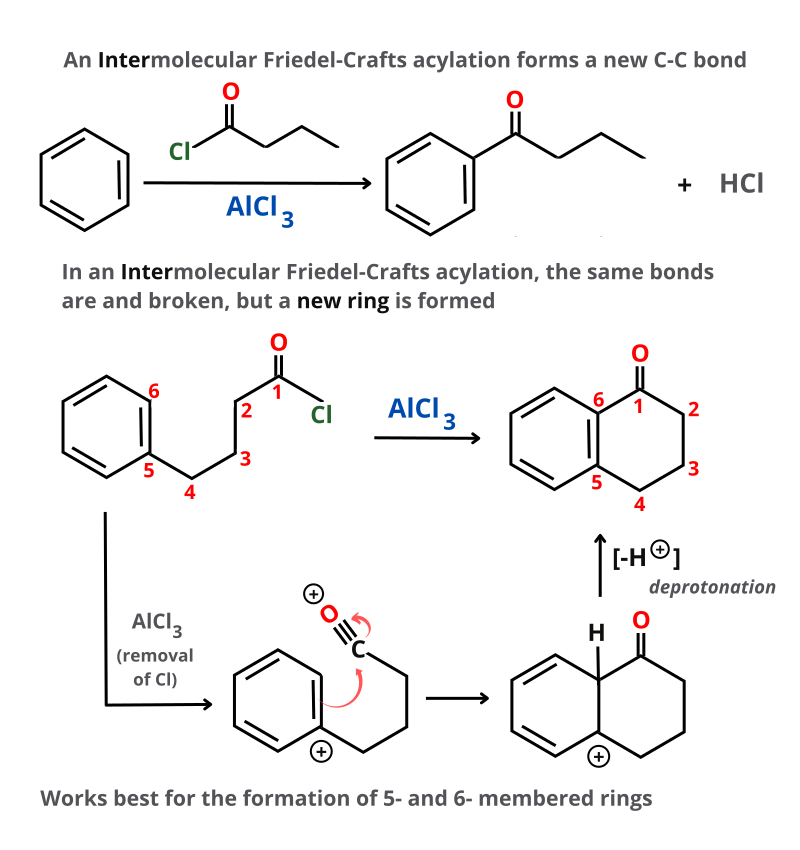
Friedel-Crafts acylation is a chemical reaction used for the synthesis of aromatic ketones. The reaction involves adding an acyl group to an aromatic ring, typically benzene or substituted benzene. This reaction is named after the chemists Charles Friedel and James Crafts, who discovered the reaction in 1877. The Friedel-Crafts acylation reaction is a type of electrophilic aromatic substitution reaction. In this reaction, the electrophile is an acylium ion formed from an acyl chloride or an acid anhydride.

Reaction

The Friedel-Crafts acylation reaction is a two-step process. The first step involves the formation of an intermediate complex between the Lewis acid catalyst and the aromatic ring. The second step consists of the reaction between the intermediate complex and the acylium ion.

Friedel - Crafts Acylation

Step 1: Formation of the intermediate complex

In the first step of the reaction, a Lewis acid catalyst, typically aluminum chloride (AlCl3) or ferric chloride (FeCl3), reacts with an aromatic ring to form an intermediate complex. The Lewis acid catalyst is an electron acceptor, forming a complex with the electron-rich aromatic ring. This complex is called a Friedel-Crafts complex.

Step 2: Reaction between the intermediate complex and the acylium ion

In the second step of the reaction, the acylium ion reacts with the Friedel-Crafts complex to form a new carbon-carbon bond. The acylium ion acts as an electrophile and is attracted to the electron-rich aromatic ring. The carbon atom in the acylium ion bonded to the carbonyl group is attacked by the electron-rich aromatic ring, forming a new carbon-carbon bond. This results in the formation of an aromatic ketone.

Mechanism

The Friedel-Crafts acylation mechanism involves the formation of an intermediate complex between the Lewis acid catalyst and the aromatic ring. This intermediate complex is highly reactive and can undergo various reactions.

The mechanism of the Friedel-Crafts acylation reaction can be divided into three stages:

(1) Activation of the acylating agent, (2) Formation of the Friedel-Crafts complex, and (3) Reaction between the Friedel-Crafts complex and the acylium ion.

Stage 1: Activation of the acylating agent

The acylating agent, typically an acyl chloride or an acid anhydride, is activated by the Lewis acid catalyst. The Lewis acid catalyst, typically aluminum chloride or ferric chloride, forms a complex with the acylating agent, making it more electrophilic. This is because the Lewis acid catalyst has an electron-deficient center that can accept electrons from the acylating agent, making it more reactive.

Stage 2: Formation of the Friedel-Crafts complex

The activated acylating agent reacts with the Lewis acid catalyst to form an intermediate, Friedel-Crafts complex. The Lewis acid catalyst acts as a Lewis acid and accepts electrons from the aromatic ring. This results in the formation of a carbocation intermediate on the aromatic ring.

Stage 3: Reaction between the Friedel-Crafts complex and the acylium ion

In the final stage of the reaction, the acylium ion reacts with the Friedel-Crafts complex to form a new carbon-carbon bond. The acylium ion acts as an electrophile and is attracted to the electron-rich aromatic ring. The carbon atom in the acylium ion that is bonded to the carbonyl group is attacked by the electron-rich aromatic ring, forming a new carbon-carbon bond. This results in forming an intermediate complex stabilized by the Lewis acid catalyst. The complex undergoes a series of rearrangements and finally eliminates the Lewis acid catalyst to create the final product, which is an aromatic ketone. Overall, the mechanism of the Friedel-Crafts acylation reaction involves the activation of the acylating agent by the Lewis acid catalyst, the formation of the Friedel-Crafts complex between the activated acylating agent and the aromatic ring, and the reaction between the Friedel-Crafts complex and the acylium ion to form an intermediate complex that is stabilized by the Lewis acid catalyst. The intermediate complex then undergoes a series of rearrangements and eliminates the Lewis acid catalyst to form the final product, an aromatic ketone. The Friedel-Crafts acylation reaction is a powerful tool for synthesizing aromatic ketones. However, the reaction has some limitations. For example, the reaction is not very effective with substrates that contain electron-withdrawing substituents, such as nitro or cyano groups, as these groups decrease the electron density on the aromatic ring and make it less reactive towards the electrophile. Additionally, the reaction can lead to forming side products such as isomers and over-acylated products.

Conclusion

In conclusion, the Friedel-Crafts acylation reaction is a valuable tool for synthesizing aromatic ketones. The reaction involves the activation of the acylating agent by a Lewis acid catalyst, forming an intermediate complex between the activated acylating agent and the aromatic ring and a reaction between the intermediate complex and the acylium ion. The mechanism of the reaction is complex and involves a series of intermediates and rearrangements. The Friedel-Crafts acylation reaction has some limitations, but it remains an essential tool for synthesizing aromatic ketones.

Share post on

About the author

Manu Ezhava

B.Sc. (CHEMISTRY) 2015 - Gujarat University
M.Sc. (ORGANIC CHEMISTRY) 2017 - Bhavan's Sheth R.A. College of Science, Gujarat University
Ad_Hoc Assistant Professor-(December 2017 to March 2021)
Ph.D. (CHEMISTRY) Pursuing - IITRAM, Ahmedabad, Gujarat

View all posts
Leave a Reply

Your email address will not be published. Required fields are marked *