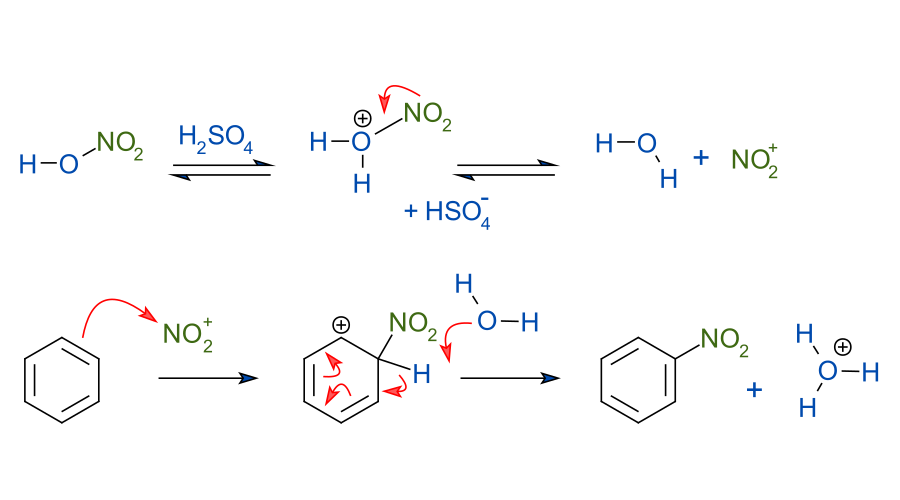
Aromatic nitration reaction

Introduction

Aromatic nitration is a commonly used reaction in organic chemistry, particularly in synthesizing organic compounds. This reaction involves substituting a nitro group (-NO2) onto an aromatic ring. The reaction is typically carried out with nitric acid and a strong acid catalyst, such as sulfuric acid. The reaction proceeds through an electrophilic aromatic substitution mechanism, which involves the formation of a nitronium ion intermediate.

NITRATION

Mechanism

The mechanism of the aromatic nitration reaction can be divided into three main steps:

Aromatic Nitration Mechanism

Formation of nitronium ion

The first step in the mechanism of the aromatic nitration reaction is the formation of the nitronium ion intermediate. Nitric acid (HNO3) is typically used as the source of the nitro group in the reaction, and it is protonated by the strong acid catalyst, such as sulfuric acid (H2SO4), to form the nitronium ion (NO2+). The nitronium ion is a powerful electrophile which is attracted to areas of high electron density, such as the aromatic ring.

\[\displaystyle HN{{O}_{3}}+{{H}_{2}}S{{O}_{4}}\rightleftharpoons HSO_{4}^{-}+{{H}_{3}}{{O}^{+}}+NO_{2}^{+}\]

Attack by the aromatic ring

The second step in the mechanism is the attack of the aromatic ring on the nitronium ion intermediate. The aromatic ring is a nucleophile, meaning that it is attracted to areas of low electron density, such as the positively charged nitronium ion. The attack of the aromatic ring on the nitronium ion results in the formation of a sigma complex, an intermediate with a positive charge on the ring carbon and a negative charge on the nitro group.

Loss of proton

The final step in the mechanism of the aromatic nitration reaction is the loss of a proton to regenerate the aromatic ring. The loss of a proton from the sigma complex results in forming the final product, an aromatic compound with a nitro group attached to the ring. A strong acid catalyst, such as sulfuric acid, is typically used to protonate the sigma complex and facilitate the loss of the proton.

Overall Reaction

The overall reaction for the aromatic nitration reaction can be represented as follows:

\[\displaystyle Ar-{{H}^{+}}+HN{{O}_{3}}+{{H}_{2}}S{{O}_{4}}\rightleftharpoons Ar-N{{O}_{2}}+HSO_{4}^{-}+{{H}_{2}}O\]

Where Ar represents the aromatic ring.

Conclusion

The aromatic nitration reaction is essential in organic chemistry, particularly in synthesizing organic compounds. The reaction proceeds through an electrophilic aromatic substitution mechanism, which involves the formation of a nitronium ion intermediate. The reaction is typically carried out with nitric acid and a strong acid catalyst, such as sulfuric acid, and results in substituting a nitro group onto an aromatic ring.

Share post on

About the author

Manu Ezhava

B.Sc. (CHEMISTRY) 2015 - Gujarat University
M.Sc. (ORGANIC CHEMISTRY) 2017 - Bhavan's Sheth R.A. College of Science, Gujarat University
Ad_Hoc Assistant Professor-(December 2017 to March 2021)
Ph.D. (CHEMISTRY) Pursuing - IITRAM, Ahmedabad, Gujarat

View all posts

Leave a Reply

Your email address will not be published. Required fields are marked *