RELAXATION METHOD

What is the Relaxation method?

This is one of the techniques for a very fast reaction. The flow technique is explained as limited by the speed with which it is possible to mix the solution. There is no difficulty using optical or other techniques for very fast reactions, but for a hydrodynamic reason, it is impossible to mix two or more solutions in less than 10-3 s.

Suppose the half-life is less than 10-3 s, and the reaction is complete before mixing; any rate measurement will be the rate of mixing, not the rate of reaction.

Strong acid by a strong base, the neutralization in an aqueous solution of the reaction is,

\[\displaystyle {{H}^{+}}+O{{H}^{-}}\to {{H}_{2}}O\]

Any techniques for mixing solutions cannot measure ordinary condition half-life of 10-6 or less and the rate. These technical problems are overcome by developing a group called relaxation methods.

This method differs from conventional kinetics methods in that the system is initially at equilibrium under a given set of conditions and that conditions are sudden change; a system is no longer at equilibrium and relaxes to a new state of equilibrium.

The relaxation speeds can be measured by spectrophotometry and the rate constant obtained. There are so many ways in which the condition are distributed.

What is the temperature jump or T- jump method?

The first is by changing the hydrostatic pressure, and the second is to increase the temperature, usually by a rapid discharge of a capacitor; this method is called the temperature jump or T- jump method.

That is possible to increase the temperature of a small cell containing a reaction mixture by a few degrees in less than 10-7 s, which is sufficiently fast to permit the study of the most rapid purely chemical processes.

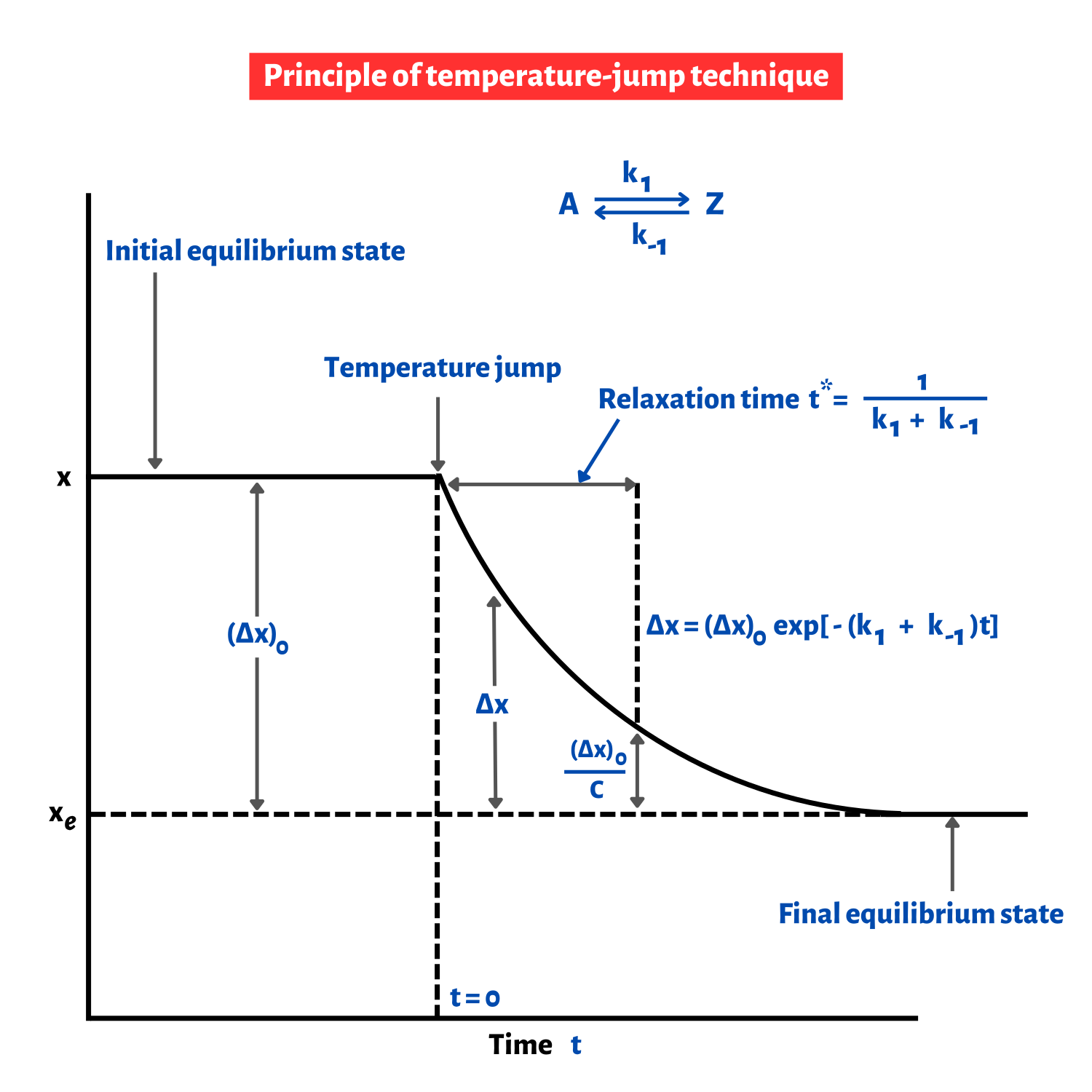
Principle of temperature-jump technique

A principle of the method is shown in the figure; suppose that the reaction is of the simple type,

\[\displaystyle A\underset{{{{k}_{{-1}}}}}{\overset{{{{k}_{1}}}}{\longleftrightarrow}}Z\]

The process is first-order in both directions. In the initial state of equilibrium, the product Z is at a specific concentration and this particular concentration until the temperature jump occurs. At this time, the concentration changes to another value higher or lower than the initial value according to the sign of ∆H for the reaction.

The shape of the curve during the relaxation phase; the sum of the rate constant, k1 + k-1, is shown,

Suppose a0 is the sum of the concentration of A and Z, x is the concentration of Z at any time, and A is  a0 – x. For kinetics equation is,

\[\displaystyle \frac{{dx}}{{dt}}={{k}_{1}}\left( {{{a}_{0}}-x} \right)-{{k}_{{-1}}}x----(1)\]

xe = concentration of Z at equilibrium,

\[\displaystyle {{k}_{1}}\left( {{{a}_{0}}-{{x}_{e}}} \right)-{{k}_{{-1}}}{{x}_{e}}=0----(2)\]

The deviation of x from equilibrium, 

\[\displaystyle \Delta x=x-{{x}_{e}}\]
\[\displaystyle \frac{{d\Delta x}}{{dt}}=\frac{{dx}}{{dt}}={{k}_{1}}\left( {{{a}_{0}}-x} \right)-{{k}_{{-1}}}x---(3)\]

Now, subtraction of the expression in equation (2) gives,

\[\displaystyle \frac{{d\Delta x}}{{dt}}={{k}_{1}}\left( {{{x}_{e}}-x} \right)+{{k}_{{-1}}}\left( {{{x}_{e}}-x} \right)---(4)\]
\[\displaystyle =-\left( {{{k}_{1}}+{{k}_{{-1}}}} \right)\Delta x----(5)\]

Therefore, the quantity of ∆x differs with time in the same way as the concentration of the reactant in a first-order reaction.

Now, integration of equation (5) to the condition that ∆x =(∆x)0, when t = 0, leads to,

\[\displaystyle \ln \left[ {\frac{{{{{\left( {\Delta x} \right)}}_{0}}}}{{\Delta x}}} \right]=\left( {{{k}_{1}}+{{k}_{{-1}}}} \right)t----(6)\]

T is the relaxation time is defined as the time corresponding to,

\[\displaystyle \frac{{{{{\left( {\Delta x} \right)}}_{0}}}}{{\Delta x}}=e---(7)\]

or

\[\displaystyle \ln \left[ {\frac{{{{{\left( {\Delta x} \right)}}_{0}}}}{{\Delta x}}} \right]=1-----(8)\]

The relaxation time is the time at a distance from equilibrium is 1/e of the initial distance shown in the figure; from equations (6) and (8), it follows that,

\[\displaystyle T=\frac{1}{{{{k}_{1}}+{{k}_{{-1}}}}}----(9)\]

 By experimentally determining T for such a system, k1 and k-1 can be calculated. If the ratio k1/k-1 is an equilibrium constant that can be determined directly, the individual constants k1 and k-1 can be obtained.

Share post on

About the author

Bhoomika Sheladiya

BSc. (CHEMISTRY) 2014- Gujarat University
MSc. (PHYSICAL CHEMISTRY) 2016 - School of Science, Gujarat University

Junior Research Fellow (JRF)- 2019
AD_HOC Assistant Professor-(July 2016 to November 2021)

View all posts
Leave a Reply

Your email address will not be published. Required fields are marked *