BIRCH REDUCTION

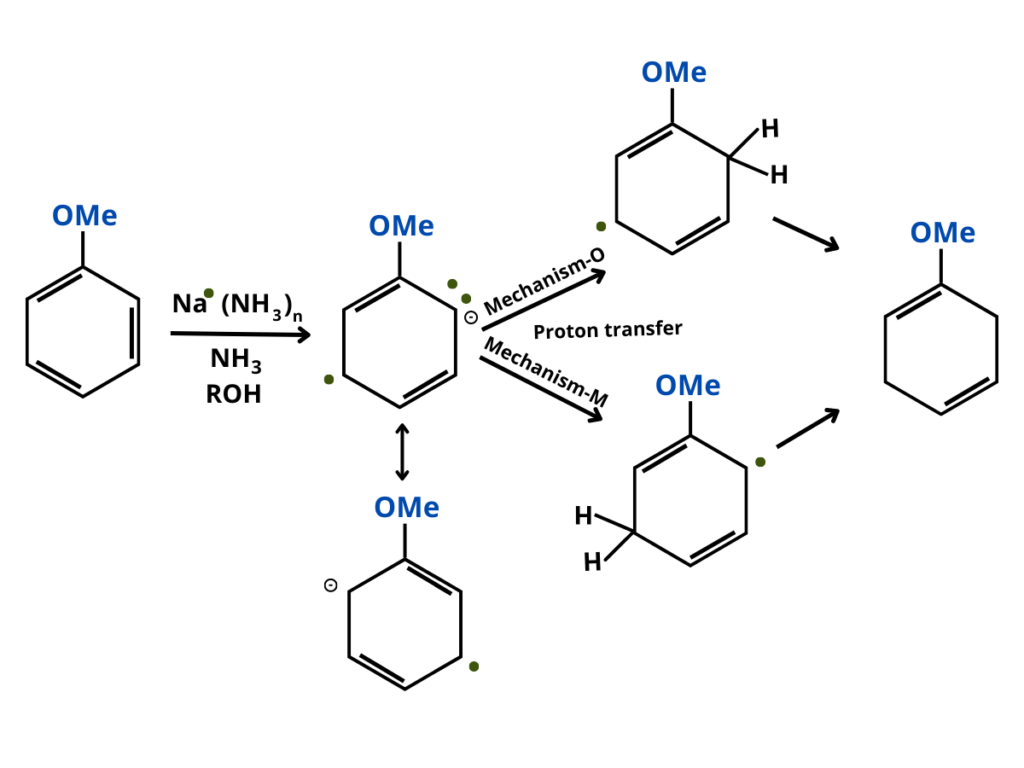
The Birch reduction is a powerful method for reducing aromatic compounds to cyclic dienes or arenes with electron-rich substituents. The mechanism of the Birch reduction involves the generation of a radical anion intermediate, which can then undergo protonation or coupling reactions to form the final product.

Birch-Reduction

Birch-Reduction

Here is a step-by-step description of the Birch reduction mechanism:

Mechanism of the Birch reduction

Mechanism of the Birch reduction

The reaction begins with the addition of a strong base, such as alkali metals or lithium amides, to an aromatic compound with electron-withdrawing groups. The base removes a proton from the aromatic ring to form a radical anion intermediate, which is stabilized by the electron-withdrawing groups. The electron density is shifted to the ortho and para positions relative to the substituent.

Formation of 1,4-cyclohexadiene intermediate

The radical anion intermediate then undergoes a series of steps to form a 1,4-cyclohexadiene intermediate. This intermediate is formed by an intramolecular hydrogen transfer from the ortho or para position of the aromatic ring to the radical anion, followed by a second electron transfer to form a new anionic center at the adjacent carbon.

Protonation or coupling

The 1,4-cyclohexadiene intermediate can then undergo either protonation or coupling to form the final product. Protonation occurs when an acidic proton, such as a solvent molecule, is added to the anionic center to form the reduced arene. Alternatively, coupling reactions between two 1,4-cyclohexadiene intermediates can form cyclic dienes, which can undergo further functionalization reactions.

The Birch reduction is a highly selective method for reducing aromatic compounds with electron-withdrawing groups and can be used to selectively reduce multiple substituents on a single aromatic ring. The mechanism involves the formation of a radical anion intermediate, followed by a series of steps to form a 1,4-cyclohexadiene intermediate, which can then undergo protonation or coupling reactions to form the final product.

Birch reduction is a versatile method for reducing aromatic compounds and can be varied in several ways to achieve different outcomes. Here are a few examples of how the Birch reduction can be varied:

(i) Choice of base

The choice of the base can affect the selectivity of the Birch reduction. For example, using a bulky base such as potassium tert-butoxide can increase the selectivity for reducing ortho and para positions over the meta positions. On the other hand, using a smaller base like lithium or sodium can increase the selectivity for meta positions.

(ii) Variation in the electron-withdrawing group

The choice of the electron-withdrawing group can also affect the selectivity and reactivity of the Birch reduction. For example, stronger electron-withdrawing groups like nitro (-NO2) or cyano (-CN) groups can give higher yields and selectivity for the reduced product. However, milder electron-withdrawing groups such as carbonyl (-C=O) or ester (-COOR) groups may not give as high of a yield but may still undergo reduction.

(iii) Use of different solvents

The choice of solvent can affect the rate and selectivity of the Birch reduction. For example, polar aprotic solvents such as dimethyl sulfoxide (DMSO) or dimethylformamide (DMF) can increase the reaction rate but may also increase the amount of side reactions. Nonpolar solvents like toluene or benzene can be used to decrease side reactions but can also reduce the rate of the reaction.

(iv) Use of different reaction conditions

The reaction conditions can also be varied to affect the outcome of the Birch reduction. For example, the temperature and reaction time can be changed to optimize the reduced product yield .

(v) Coupling reactions

Coupling reactions can be used to generate different products from the Birch reduction. For example, coupling two reduced products can form a new C-C bond, which can lead to the formation of bicyclic or polycyclic products.

In summary, the Birch reduction can be varied in several ways to achieve different outcomes, including the choice of base, variation in the electron-withdrawing group, use of different solvents, different reaction conditions, and coupling reactions. These variations make the Birch reduction a versatile tool for synthetic organic chemistry.

Share post on

About the author

Manu Ezhava

B.Sc. (CHEMISTRY) 2015 - Gujarat University
M.Sc. (ORGANIC CHEMISTRY) 2017 - Bhavan's Sheth R.A. College of Science, Gujarat University
Ad_Hoc Assistant Professor-(December 2017 to March 2021)
Ph.D. (CHEMISTRY) Pursuing - IITRAM, Ahmedabad, Gujarat

View all posts

Leave a Reply

Your email address will not be published. Required fields are marked *