Aromatic halogenation reaction

Introduction

Aromatic halogenation is a type of electrophilic aromatic substitution reaction in which a halogen atom replaces a hydrogen atom on an aromatic ring. This reaction is commonly used to synthesize halogenated aromatic compounds, which have various applications in industry and medicine. In this blog, we will discuss the mechanism of aromatic halogenation, including the role of the halogen carrier and the effect of substituents on the reaction.

Chlorination -Bromination AROMATIC HALOGENATION REACTION

Mechanism of Aromatic Halogenation

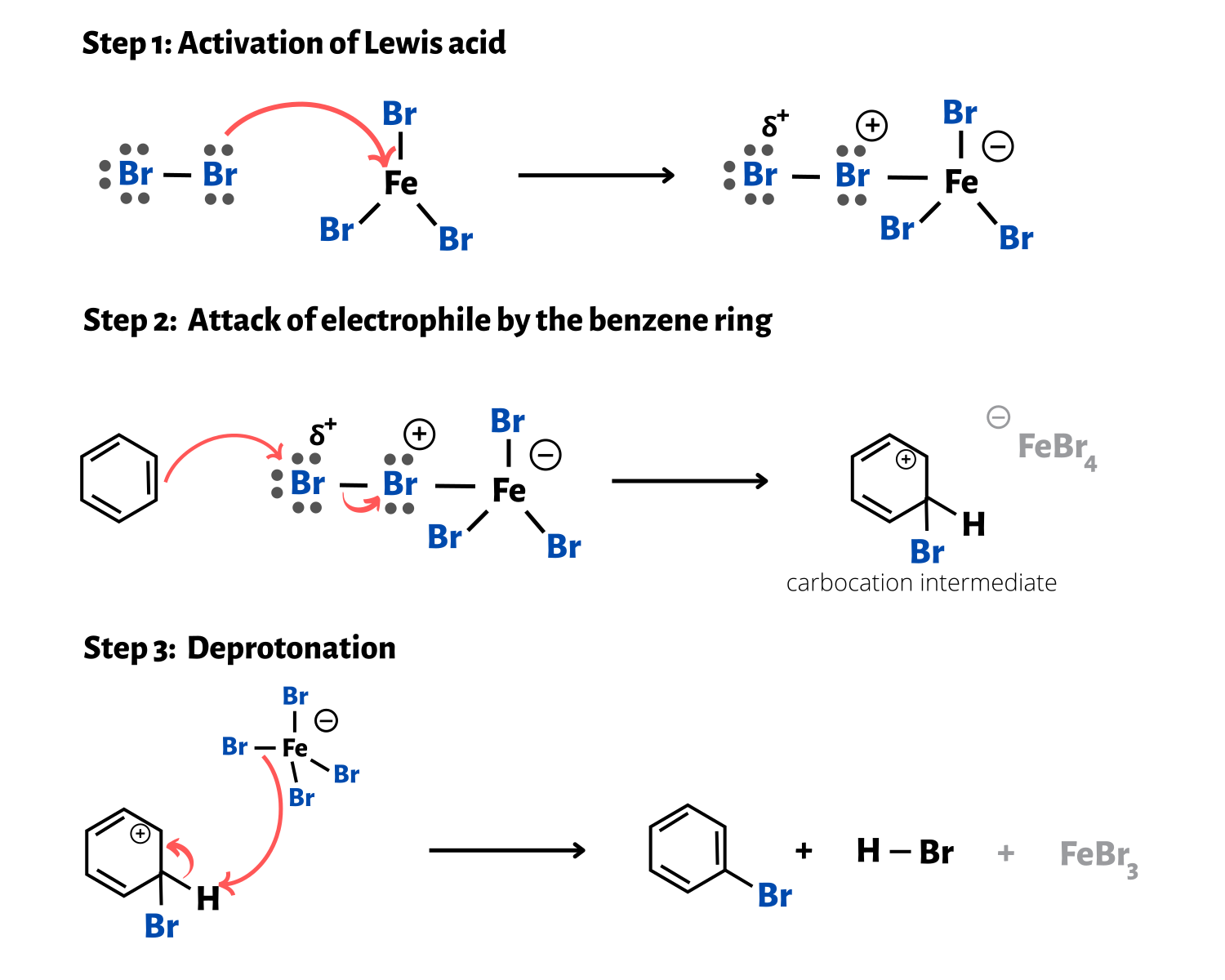
The mechanism of aromatic halogenation involves two main steps: the generation of an electrophilic halogen species and the attack of this species on the aromatic ring.

Mechanism of Aromatic Halogenation

Generation of Electrophilic Halogen Species

In order for the halogenation reaction to occur, an electrophilic halogen species must be generated. Halogens are not strong electrophiles, so a halogen carrier, such as iron or aluminum chloride, is typically used to facilitate the reaction. The halogen carrier acts as a Lewis acid, accepting an electron pair from the halogen to form a halogen cation, which is a strong electrophile. For example, when chlorine is used as the halogen, the reaction can be carried out using iron(III) chloride (FeBr3) as the halogen carrier:

\[\displaystyle FeB{{r}_{3}}+B{{r}_{2}}\to FeBr_{4}^{-}+B{{r}^{+}}\]

The formation of the bromonium ion (Br+) is the key step in the reaction. This cation is a strong electrophile that can attack the aromatic ring.

Attack of Electrophilic Halogen Species on the Aromatic Ring

Once the electrophilic halogen species has been generated, it can attack the aromatic ring, substituting a hydrogen atom with a halogen atom. The mechanism of attack depends on the substitution pattern of the aromatic ring. For a mono-substituted benzene ring, the electrophilic halogen species attacks at the ortho and para positions, as these positions are more electron-rich than the meta position. The electrophile attack on the ortho or para position forms a resonance-stabilized intermediate known as an arenium ion or sigma complex.

For example, when chlorine is used as the halogen, the reaction with toluene can result in ortho and para chlorotoluene: The attack of the electrophilic Br+ ion at the ortho or para position of the toluene ring results in the formation of an arenium ion intermediate. The arenium ion intermediate is stabilized by resonance, as shown below:

Attack of Electrophilic Halogen Species on the Aromatic Ring

In the next step of the reaction, the intermediate loses the proton attached to the aromatic ring, resulting in the formation of the ortho or para-chlorotoluene product. For a di-substituted benzene ring, the halogenation reaction can occur at either of the two positions, depending on the relative electron density of the substituents. If the two substituents are identical, the reaction can occur at either position with equal probability. If the two substituents are different, the reaction occurs preferentially at the more electron-rich position.

For example, when chlorine is used as the halogen, the reaction with o-xylene results in a mixture of 2,3-dichloro- and 2,6-dichloro-xylene:

The two substituents are identical in the case of o-xylene, so that the reaction can occur at either position with equal probability. The reaction at the 2-position results in the formation of the 2,3-dichloro-xylene product, while the reaction at the 6-position results in the formation of the 2,6-dichloro-xylene product.

Overall, the halogenation of aromatics is a highly useful and versatile reaction with various applications in various fields, including synthesizing pharmaceuticals, agrochemicals, and materials science. Understanding the mechanism of the halogenation reaction can aid in developing new and more efficient methods for conducting this reaction and optimizing existing methods. It is important to note that the mechanism of halogenation can vary depending on the type of halogen and the reaction conditions.

For example, the mechanism of iodination may differ significantly from that of chlorination or bromination. Additionally, the use of different halogenation agents or catalysts can also affect the mechanism. Despite these variations, the basic principles and steps of the halogenation reaction remain the same. The reaction involves the generation of an electrophilic halogen species, which then attacks the electron-rich aromatic ring to form a halogenated product. Careful control of reaction conditions, such as temperature, solvent, and catalyst, can help to optimize the reaction and control the selectivity and regiochemistry of the halogenation.

Summary

In summary, the halogenation of aromatics is a beneficial and versatile reaction that can be carried out using a variety of halogenating agents and catalysts. The reaction mechanism involves the generation of an electrophilic halogen species, which attacks the electron-rich aromatic ring to form a halogenated product. Understanding the mechanism of this reaction can aid in developing new and more efficient methods for conducting this reaction, as well as optimizing existing methods.

Share post on

About the author

Manu Ezhava

B.Sc. (CHEMISTRY) 2015 - Gujarat University
M.Sc. (ORGANIC CHEMISTRY) 2017 - Bhavan's Sheth R.A. College of Science, Gujarat University
Ad_Hoc Assistant Professor-(December 2017 to March 2021)
Ph.D. (CHEMISTRY) Pursuing - IITRAM, Ahmedabad, Gujarat

View all posts

Leave a Reply

Your email address will not be published. Required fields are marked *