ACTIVATED COMPLEX THEORY (ACT) OF REACTION RATE

What is an Activated Complex?

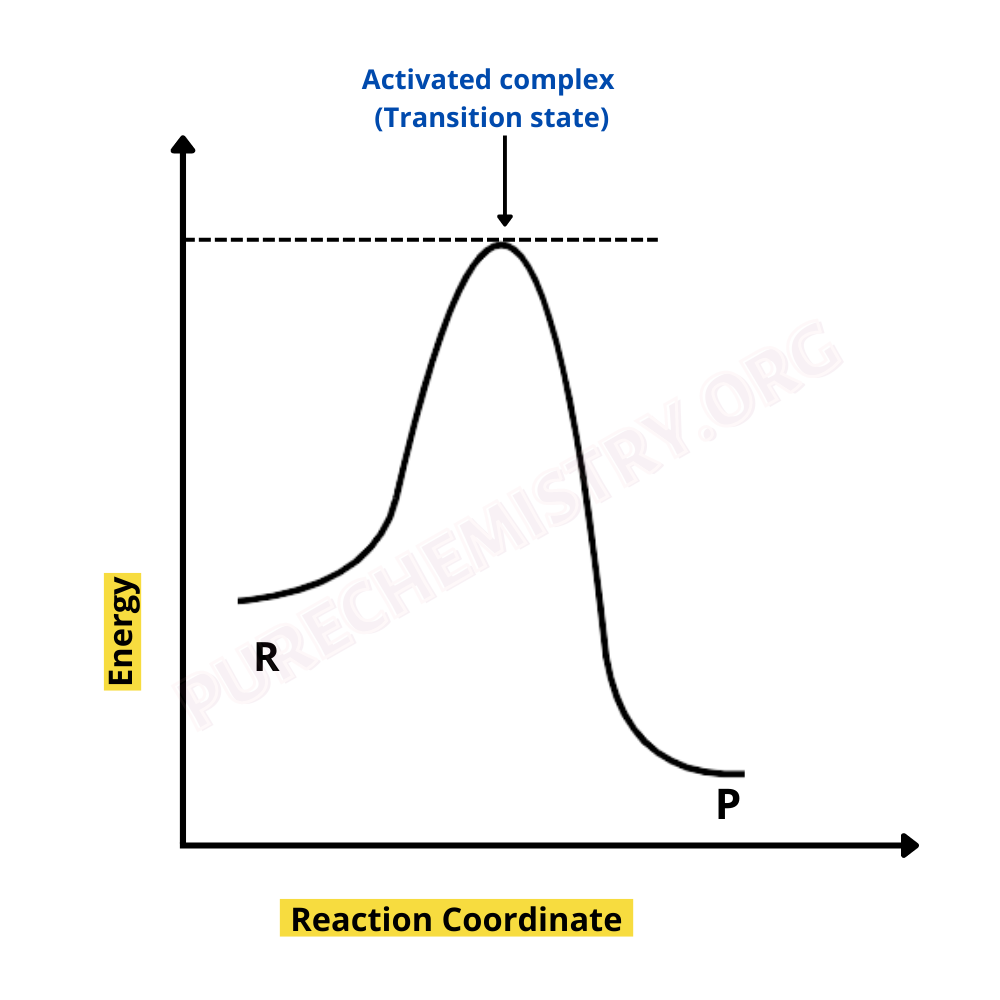
The activated complex, also known as the transition state, is the highest energy level of chemical reaction that bonds reactant and product, breaking and forming simultaneously.

In 1935, Eyring, Polanyi and Evans gave an activated complex theory. According to him, the molecular reaction between two molecules A and B is the first formation of an activated complex, then this complex decomposes and is converted into the product.

Transition state theory and absolute rate theory is another name of activated complex theory. 

ACTIVATED COMPLEX THEORY (ACT) OF REACTION RATE

Activated complex theory (ACT) of reaction rate

 The activated complex theory, a simple molecular reaction, 

\[\displaystyle A+B\rightleftharpoons {{\left[ {A.B} \right]}^{*}}\to \text{Product}\]

Here,

[AB]* = activated complex and k* = equilibrium constant

The formation constant

\[\displaystyle {{\text{k}}^{*}}=\frac{{{{{\left[ {A.B} \right]}}^{*}}}}{{\left[ A \right]\left[ B \right]}}\]

And the concentration of activated complex is,

\[\displaystyle {{\left[ {A.B} \right]}^{*}}={{\text{k}}^{*}}\left[ A \right]\left[ B \right]\]

Now, according to statistical thermodynamics and quantum mechanics,

\[\displaystyle k=\frac{{RT}}{{Nh}}.{{\text{k}}^{*}}---(1)\]

Now, the equilibrium constant k* is expressed in the form of standard free energy ΔG*

\[\displaystyle \begin{array}{l}\Delta G=-RT\ln k\text{ }\!\!\And\!\!\text{ }\Delta G=\Delta H-T\Delta S\\\Delta {{G}^{*}}=-RT\ln {{k}^{*}}\text{ }\!\!\And\!\!\text{ }\Delta {{G}^{*}}=\Delta {{H}^{*}}-T\Delta {{S}^{*}}----(2)\end{array}\]
\[\displaystyle \Delta {{G}^{*}}=-RT\ln {{k}^{*}}\text{ }\!\!\And\!\!\text{ }\Delta {{G}^{*}}=\Delta {{H}^{*}}-T\Delta {{S}^{*}}----(2)\]

With the activated complex, we can write,

\[\displaystyle \ln {{k}^{*}}=-\frac{{\Delta {{G}^{*}}}}{{RT}}----(3)\]

Now, put the value of equation (2) in equation (3), and we get,

\[\displaystyle \ln {{k}^{*}}=\frac{{-\left[ {\Delta {{H}^{*}}-T\Delta {{S}^{*}}} \right]}}{{RT}}\]
\[\displaystyle \ln {{k}^{*}}=\frac{{-\Delta {{H}^{*}}+T\Delta {{S}^{*}}}}{{RT}}---(4)\]

Either we can write as,

\[\displaystyle {{k}^{*}}={{e}^{{\frac{{-\Delta {{H}^{*}}+T\Delta {{S}^{*}}}}{{RT}}}}}----(5)\]
\[\displaystyle {{k}^{*}}={{e}^{{\frac{{-\Delta {{H}^{*}}}}{{RT}}}}}.{{e}^{{\frac{{\Delta {{S}^{*}}}}{R}}}}----(6)\]

Substituting the value of equation (6) in equation (1), we obtain,

\[\displaystyle k=\frac{{RT}}{{Nh}}.{{e}^{{\frac{{-\Delta {{H}^{*}}}}{{RT}}}}}.{{e}^{{\frac{{\Delta {{S}^{*}}}}{R}}}}---(7)\]

The equation is an Eyring Equation, also known as an activated complex theory equation.

Share post on

About the author

Bhoomika Sheladiya

BSc. (CHEMISTRY) 2014- Gujarat University
MSc. (PHYSICAL CHEMISTRY) 2016 - School of Science, Gujarat University

Junior Research Fellow (JRF)- 2019
AD_HOC Assistant Professor-(July 2016 to November 2021)

View all posts
Leave a Reply

Your email address will not be published. Required fields are marked *